What to Track on a GLP-1, and How to Bring It to Your Doctor
The things worth logging on Ozempic, Wegovy, Zepbound or Mounjaro, why each one matters according to the labels and guidelines, and a simple way to prepare for your next appointment.
7 min read

On a GLP-1, track five things: every dose (date, amount, and the ones you missed), your weight and waist under the same conditions, side effects with how bad they were and when they started, appetite, energy and sleep, and your supplies. Those are the things your prescriber needs to judge whether a dose is working, whether to step up or slow down, and whether a symptom needs attention. Bring a one-page summary, not your memory.
Why keep a log at all?
Self-monitoring isn't a fad. The US Preventive Services Task Force recommends intensive behavioural programmes for adults with obesity that include self-monitoring alongside nutrition, activity and relapse prevention, as summarised in a 2025 joint advisory on GLP-1 therapy (Mozaffarian et al., 2025).
And several decisions on a GLP-1 depend on dated facts:
- Is it working? The National Institute of Diabetes and Digestive and Kidney Diseases says that if you haven't lost at least 5% of your starting weight after 12 weeks on the full dose, your health care professional will probably suggest a change (NIDDK). That needs a starting weight, a date you reached the full dose and weights since.
- Can you step up? The labels allow delaying a step if a dose isn't tolerated (Wegovy label). That depends on what happened after the last step.
- What to do about a missed dose? The rules depend on how many days have passed, and on whether two or more were missed in a row. See missed GLP-1 doses.
The five things to track
| What | Details worth logging | Why it matters |
|---|---|---|
| Doses | Date, time, dose in mg, which pen or vial; missed and late doses marked honestly | Missed-dose rules, restarting after a gap, step-up timing, the contraception window on tirzepatide |
| Weight and waist | Same time of day and conditions; waist at the same spot | The 5%-at-12-weeks check; plateaus; waist can keep changing when weight slows |
| Side effects | What, how severe, when it started relative to the last dose, when it resolved | Deciding whether to hold a step; spotting warning signs |
| Appetite, energy, sleep | A quick 1 to 5 rating a few times a week | Under-eating, fatigue and how you're coping beyond the scale |
| Supplies | Strength, lot, printed expiry, date opened; doses left | Vial discard dates, avoiding mix-ups between strengths, refills on time |
Doses
Log the dose you actually took, when you took it. If you skipped one, write that down too. "Not logged" and "skipped" are different from "taken", and your clinician needs to know which.
If you use tirzepatide and oral contraceptives, the label advises a non-oral or backup method for 4 weeks after starting and after each dose increase (Zepbound label). Your step-up dates define those windows.
If you use a vial, note which vial and its concentration. The FDA has documented overdoses from confusion between mL, mg and units (FDA, 2024). See reconstitution and syringe math.
Weight and waist
Weigh at the same time of day, under the same conditions, and look at the trend over weeks rather than single days. Add a waist measurement every couple of weeks. In STEP 4, continued semaglutide improved waist circumference by 9.7 cm compared with switching to placebo (Rubino et al., JAMA, 2021), and it's a useful second line when the scale stalls. See weight loss plateaus.
Side effects
Write the symptom in your own words, rate it mild, moderate or severe, and note when it started relative to your last dose or step-up. The labels say stomach side effects are most common during dose escalation, so timing is the useful part. Our side effects timeline explains why.
Also note anything the labels list as a warning sign: severe stomach pain that won't go away, upper stomach pain with fever or yellowing skin, nausea, vomiting or diarrhea that doesn't stop, or signs of an allergic reaction. Those don't wait for the next appointment.
Appetite, energy and sleep
GLP-1s cut how much people eat; the joint advisory notes calorie intake falls by 16% to 39% compared with placebo. Rating appetite and energy a few times a week shows whether you're eating too little, which matters for muscle. See muscle loss and protein.
Supplies
For multi-dose vials, the FDA recommends discarding them 28 days after first use, even if some is left (FDA). That only works if you wrote down the date you opened it. Multi-dose pens and vials, like the Zepbound KwikPen with four doses, also need counting; NEXA's supply tracker keeps an estimate of what's left.
Things your clinician may ask that people forget
- Other medicines. GLP-1s slow stomach emptying and can affect how other oral medicines are absorbed, according to the Wegovy label. Keep a current list, including supplements.
- Planned surgery, endoscopy or sedation. The labels warn about pulmonary aspiration during anaesthesia and ask patients to mention planned procedures. Know the date of your last dose.
- Pregnancy plans. The semaglutide labels say to stop at least 2 months before a planned pregnancy.
- Low blood sugar, if you have type 2 diabetes and take insulin or a sulfonylurea.
- Heart rate. The Wegovy label tells clinicians to monitor heart rate at regular intervals.
- Vision changes, if you have type 2 diabetes. The label lists diabetic retinopathy complications.
How to prepare for a GLP-1 appointment
A clinician has limited time. A one-page summary does more than a phone full of screenshots.
Bring:
- Your current dose, the date you started it, and every step-up date.
- Any missed or late doses since the last visit.
- Your starting weight, current weight and the trend, plus waist if you track it.
- Side effects: what, how bad, when, whether resolved.
- A list of all medicines and supplements.
- Any upcoming procedures or pregnancy plans.
Questions worth asking:
- Am I on track, given when I reached my full dose?
- Should I step up, stay, or slow down?
- What should I do if I miss a dose, given my product?
- Which symptoms mean I should call before the next visit?
- What's the plan if I want or need to stop? See stopping a GLP-1.
How NEXA keeps this in one place
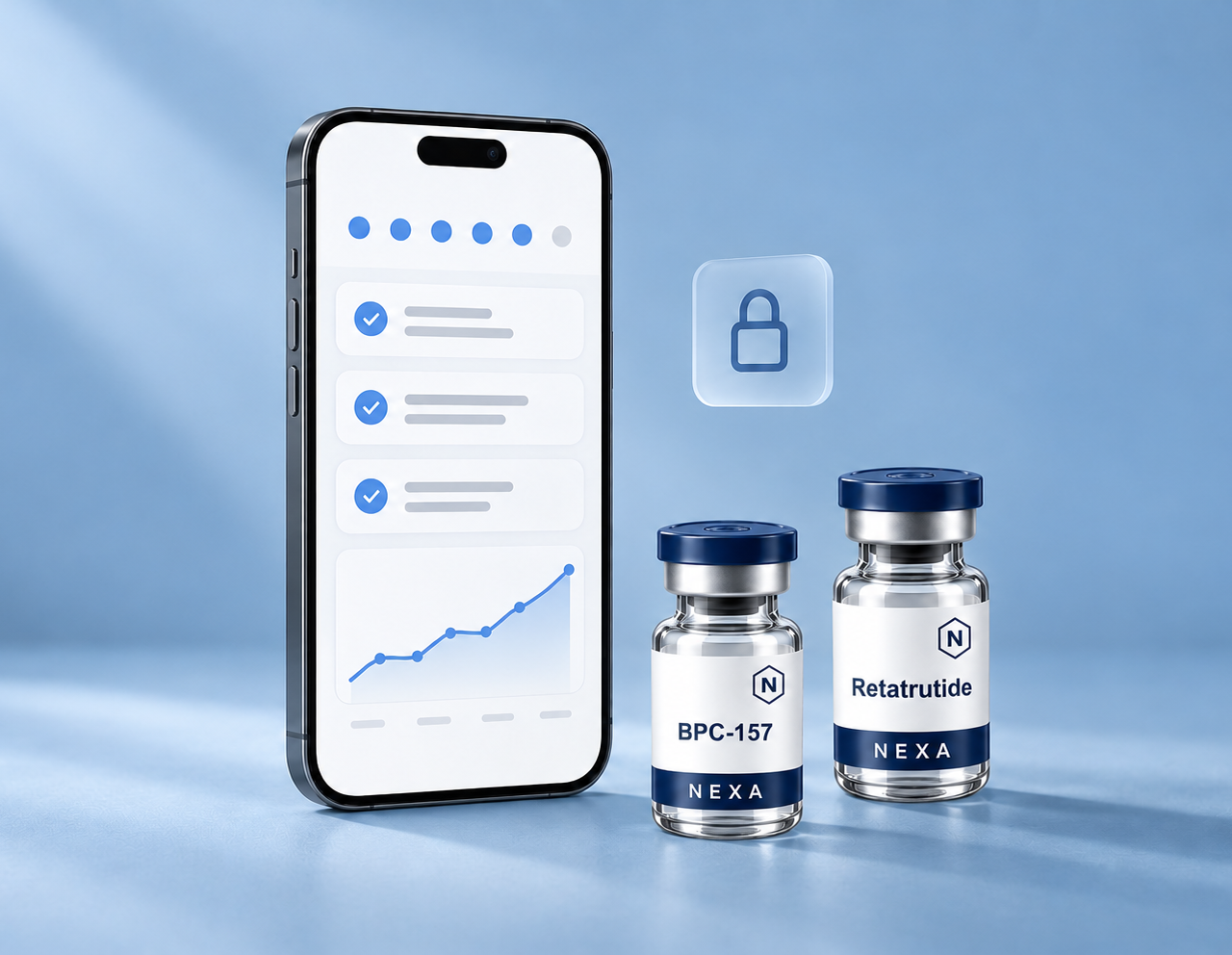
We built NEXA to be this log. It's a journal for your stack:
- Plans and doses. Enter the schedule you were given. Log a dose in one tap; mark a time as skipped; log late with the real time. A passed time with nothing logged shows "Not logged yet", never "taken". Edits keep a history with a reason. See the GLP-1 tracker.
- Check-ins. Weight, waist, sleep, energy, appetite and more, on one progress chart, plus private progress photos you can compare side by side.
- Symptoms. In your own words, with severity, start date and ongoing or resolved.
- Supplies. Pens and vials with strength, lot, printed expiry and opened date, and an estimate of what's left. See vial and pen supply.
- Reports. A doctor report as a PDF (summary or full) or CSV, for 30, 90 or 180 days or all time. Notes, photos and your name stay out unless you switch them on.
- Ask NEXA (optional). If you turn it on, you can ask "Prepare for my appointment" or "Summarise my last 30 days" and it answers from your own records. See Ask NEXA.
Reminders are set per plan, and their lock-screen text never names what you take. NEXA doesn't recommend doses, judge symptoms or tell you what to do. It keeps an accurate record you can share when you choose.
NEXA is a tracking journal, not medical advice.
Frequently asked questions
Doses (including missed ones), weight and waist, side effects with severity and timing, appetite, energy and sleep, and your supplies.
Choose a routine you can keep, under the same conditions each time, and judge the trend over weeks. Ask your clinician what they'd like to see.
Your current dose and step-up dates, missed doses, weight trend, side effects, a list of all medicines and supplements, and any upcoming procedures or pregnancy plans.
Missed doses change what to do next. The Wegovy label, for example, says escalation should restart at a lower dose after two or more consecutive missed doses.
No. NEXA is a journal: it records what you enter and shows it back as charts and reports. It doesn't give medical advice or dosing recommendations.
Sources
- Mozaffarian D et al., "Nutritional priorities to support GLP-1 therapy for obesity: a joint Advisory", 2025. PubMed Central
- NIDDK, "Prescription Medications to Treat Overweight & Obesity", last reviewed June 2024. niddk.nih.gov
- Novo Nordisk, Wegovy (semaglutide) US prescribing information, revised 06/2026. novo-pi.com
- Eli Lilly, Zepbound (tirzepatide) US prescribing information, revised 08/2026. pi.lilly.com
- Rubino D et al., STEP 4, JAMA 2021;325(14):1414-1425. doi.org
- US FDA, "FDA alerts health care providers, compounders and patients of dosing errors associated with compounded injectable semaglutide products", 26 July 2024. fda.gov
- US FDA, "FDA's concerns with unapproved GLP-1 drugs used for weight loss", content current as of 1 October 2026. fda.gov